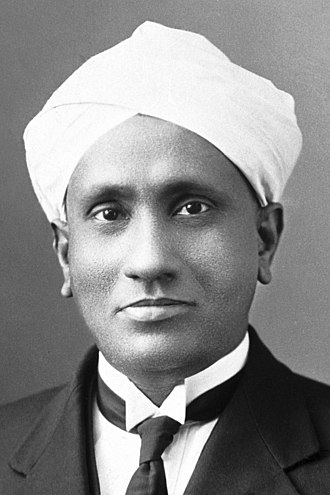
On November 7, 1888, he was born in Tiruchirappalli, a city in southern India. He was raised in an academic environment because his father was a lecturer in physics and mathematics. He enrolled in Presidency College in Madras in 1902, and after passing his B.A. exam in 1904 and winning the gold medal in physics, he went on to earn his M.A. in 1907 with the highest honours.
He wrote his first scientific article on "Unsymmetrical diffraction bands due to a rectangular aperture" when he was 18 years old and a graduate student in the British journal Philosophical Magazine in 1906. In 1907, he graduated with honours from the same university with a master's degree. The surface tension of liquids was the subject of his second paper that year, which was published in the same journal. Alongside it was Lord Rayleigh's paper on the sensitivity of the ear to sound, and it was from this paper that Lord Rayleigh first made eye contact with Raman and addressed him politely as "Professor."
Some members of the University of Calcutta Senate, particularly those who were foreigners, strongly opposed Raman's appointment as the Palit Professor because he lacked a doctorate and had never studied abroad. Mukherjee arranged for Raman to receive an honorary DSc from the University of Calcutta in 1921 as a sort of rebuttal. He travelled to Oxford that same year to give a speech at the Congress of Universities of the British Empire. The Nobel laureates J. J. Thomson and Lord Rutherford were his hosts at the time, and he had already established a solid reputation. When Mukherjee questioned him about his plans after he was elected a Fellow of the Royal Society in 1924, he responded, "The Nobel Prize, of course."
He founded the Indian Journal of Physics in 1926 and served as its founding editor. His renowned article, "A New Radiation," detailing the discovery of the Raman effect, was published in the journal's second volume.
After 15 years at Calcutta, he became Professor at the Indian Institute of Science at Bangalore (1933-1948), and since 1948 he had been the Director of the Raman Institute of Research at Bangalore, which he established and endowed himself with. He also founded the Indian Journal of Physics in 1926, of which he was later the editor. Raman sponsored the establishment of the Indian Academy of Sciences and had served as its president since its inception. He also initiated the Proceedings of that academy, in which much of his work had been published, and was president of the Current Science Association, Bangalore, which published Current Science (India).
The Viceroy of India, Lord Minto, approved its establishment in 1909, and the British government appointed its first director, Morris Travers. Raman became the fourth director and the first Indian director. During his tenure at IISc, he recruited G. N. Ramachandran, who later went on to become a distinguished X-ray crystallographer. He founded the Indian Academy of Sciences in 1934 and started publishing the academy's journal, Proceedings of the Indian Academy of Sciences (later split up into Proceedings - Mathematical Sciences, Journal of Chemical Sciences, and Journal of Earth System Science). Around that time the Calcutta Physical Society was established, the concept which he had initiated early in 1917.
Other investigations carried out by Raman were: his experimental and theoretical studies on the diffraction of light by acoustic waves of ultrasonic and hypersonic frequencies (published 1934-1942) and those on the effects produced by X-rays on infrared vibrations in crystals exposed to ordinary light. In 1948, Raman, through studying the spectroscopic behavior of crystals, approached in a new manner the fundamental problem of crystal dynamics. His laboratory has been dealing with the structure and properties of diamonds, the structure and optical behavior of numerous iridescent substances (labradorite, pearly felspar, agate, opal, and pearls).
Raman had been honored with a large number of honorary doctorates and memberships in scientific societies. He was elected a Fellow of the Royal Society early in his career (1924) and was knighted in 1929.
Raman scattering, or the Raman effect, is the inelastic scattering of photons by matter, meaning that there is both an exchange of energy and a change in the light's direction. Typically, this effect involves vibrational energy being gained by a molecule as incident photons from a visible laser are shifted to lower energies. This is called normal Stokes-Raman scattering. The effect is exploited by chemists and physicists to gain information about materials for a variety of purposes by performing various forms of Raman spectroscopy. Many other variants of Raman spectroscopy allow rotational energy to be examined (if gas samples are used) and electronic energy levels may be examined if an X-ray source is used in addition to other possibilities. More complex techniques involving pulsed lasers, multiple laser beams, and so on are known.
Raman started the experiment at the beginning of January 1928. On January 7, he discovered that no matter what kind of pure liquid he used, it always produced polarized fluorescence within the visible spectrum of light. As Raman saw the result, he was astonished that he had never observed such a phenomenon all those years before. That night he and Krishnan named the new phenomenon "modified scattering" concerning the Compton effect as an unmodified scattering. On February 16, they sent a manuscript to Nature titled "A new type of secondary radiation," which was published on March 31. For his pioneering work, Raman received the 1930 Nobel Prize in Physics and was the first Asian to receive a Nobel Prize in any branch of science.
One of Raman's interests was the scientific basis of musical sounds. He was inspired by Hermann Ludwig Ferdinand von Helmholtz's (31 August 1821–8 September 1894) The Sensations of Tone, the book he came across when he joined IACS. He published his findings prolifically between 1916 and 1921. He worked out the theory of transverse vibration of bowed string instruments based on the superposition of velocities. One of his earliest studies was on the wolf tone in violins and cellos. He studied the acoustics of various violins and related instruments, including Indian stringed instruments, and water splashes. He even performed what he called "Experiments with mechanically-played violins."
Raman also studied the uniqueness of Indian drums. His analyses of the harmonic nature of the sounds of tabla and mridangam were the first scientific studies on Indian percussion. He conducted critical research on the vibrations of the pianoforte string, which was known as Kaufmann's theory. During his brief visit to England in 1921, he managed to study how sound travels in the Whispering Gallery of the dome of St Paul's Cathedral in London, producing unusual sound effects. His work on acoustics was an important prelude, both experimentally and conceptually, to his later works on optics and quantum mechanics.
At the end of October 1970, Raman had a cardiac arrest and collapsed in his laboratory. He was moved to the hospital, where doctors diagnosed his condition and declared that he would not survive another four hours. He however survived a few days and requested to stay in the gardens of his institute surrounded by his followers.
Two days before Raman died, he told one of his former students, "Do not allow the journals of the Academy to die, for they are the sensitive indicators of the quality of science being done in the country and whether science is taking root in it or not."That evening, Raman met with the board of management of his institute in his bedroom and discussed with them the fate of the institute's management. He also willed his wife to perform a simple cremation without any rituals upon his death. He died of natural causes early the next morning on November 21, 1970, at the age of 82. Due to his pioneering work in the field of science, his birthday is celebrated nationwide as National Science Day.