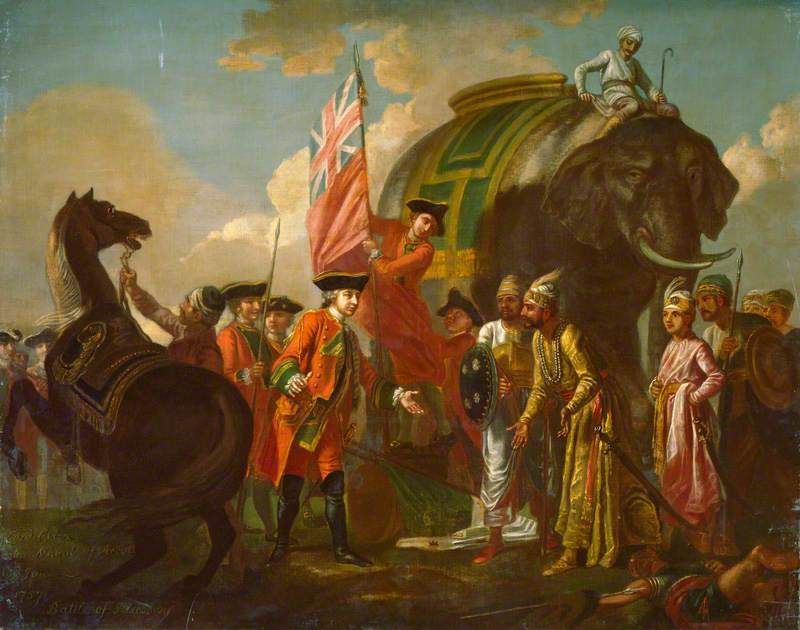
The Battle Of Plassey (1757)

The British East India Company, led by Robert Clive, decisively defeated the Nawab of Bengal and his French allies at the Battle of Plassey on June 23, 1757. The top commander of Nawab Siraj-ud-Daulah (April 9, 1756, to June 23, 1757), Mir Jafar Ali Khan (c.1691 – 1765), defected, which allowed the victory. Some of its results are:-

  • The economy of India was affected severely.
  • The British became the paramount European power in Bengal.
  • The settlement of Calcutta was made stronger and more prosperous.

How it Started

Clashes with the Nawab

The English East India Company, which was establishing its commercial operations in Bengal, arrived first, marking the beginning of everything. Job Charnock, a business administrator, arrived at the settlement of Sutanuti on August 24, 1690. To safeguard its trade factory, the British later finished building Fort William, the British East India Company's headquarters, on the east bank of the Hooghly River in 1712. Three villages made up the group: Sutanuti, Gobindapur, and Kalikata. Together, these three locations were referred to as Calcutta (modern Kolkata).

The British forces started encountering French soldiers regularly. Therefore, in 1756, the British started modernizing their defenses against their rivals in the anticipation of War (the Seven Years' War, 1756-63 ). Mirza Muhammad Siraj-ud-Daulah (commonly known as Siraj ud-Daulah), the final independent Nawab of Bengal, denounced the company's militarization and tax avoidance. When his cautions were unanswered, he launched an attack in June 1756. He temporarily assumed command of Calcutta and changed its name to Alinagar. Several East India Company officials were assassinated in the notorious Black Hole of Calcutta as a result of his seizure and destruction of Fort William.

The Black Hole of Calcutta was a cell at Fort William that measured 14 by 18 feet (4.3 x 5.5 m). On the night of June 20, 1756, Siraj-ud-forces Daulah's confined British prisoners of war inside. Numerous prisoners perished from suffocation and heat exhaustion due to the dungeon's congested conditions. A British East India Company employee named John Zephaniah Holwell (1711–1798) claimed that 23 out of 146 people who were imprisoned survived. The incident was used as proof of the nawab's heartlessness and the bravery of the British. When J.H. Little drew attention to Holwell's lack of credibility as a witness and other inconsistencies in 1915, it became obvious that the nawab's role was limited to negligence. According to a 1959 study by Brijen Kishore Gupta, the incident did take place, but only about 64 people entered and 21 people survived.

Vice Admiral Charles Watson (1714 – 1757) and Lieutenant Colonel Robert Clive (1725 – 1774), who were both at Madras, received the information. Their mission was to reclaim Calcutta. They then started preparing to topple the nawab. Clive, who was by this point 32 years old, did not lead a mixed European-Indian army of about 2,500 men until October.

Clive concluded that replacing Siraj with a different, more accommodating nawab was the best way to protect the Company's interests in Bengal. An old Commander-in-Chief called Mir Jafar Ali Khan Bahadur who was dissatisfied served as his chosen candidate. A clandestine arrangement with him was reached after lengthy conspiratorial negotiations and the large promises of bribery made to everyone involved. Siraj's spies were there during this time.

Siraj traveled south to Plassey because he knew or believed there was a plot against him, despite Clive's ardent denials to the contrary. The Thirty-Ninth of Foot's 600 British infantrymen and around 200 artillerymen with 10 field pieces and two light howitzers headed north under Clive on June 13.

The War

On June 23, 1757, a gloomy morning saw a conflict take place north of the village of Plassey (also known as Palashi), on the Hughli (Hooghly) river's bank, some 150 kilometers (93 mi) north of Calcutta (now Kolkata) and south of Murshidabad in West Bengal, the country's then-capital of Bengal Subah (now in Nadia district in West Bengal). Both Clive's army, which consisted of over 50,000 soldiers, and Nawab's army, which included 10 war elephants and more than 50 guns, were divided into three divisions. Mir Jafar Ali Khan was the commander of one division. A lightning strike at noon signaled the beginning of a severe shower of rain that lasted 30 minutes after an introductory cannonade.

When it started to rain, the conflict seemed to be reaching a deadlock. The Bengalis lacked the tarpaulins that Clive had brought to keep their powder dry. Siraj gave Mir Jafar the order to cover their explosives. But he ignored to do the same and their artillery was rendered unusable. Therefore, the Nawab ordered his cavalry to charge and was met with a withering rain of fire as his force advanced, assuming that Clive's guns had also been rendered inoperable as his own by damp powder.

At 2 pm on that day, the cavalry's commander, Mir Madan Khan, was mortally wounded by a British cannonball and died. Many of the other fighters and officers like Diwan Mohanla, Nawe Singh Hajari, and Bahadur Khan were also killed when the British guns opened fire and massacred a large number of them. The Nawab ordered his forces to retreat after learning of the death of this beloved general, which left the French artillery unit exposed. The British rushed in and took control of it. The British bombarded the nawab's positions without receiving a response after capturing the French cannon, which caused the battle's momentum to change. When Mir Jafar Ali Khan suggested retreating, Siraj lost his cool. He distrusted his generals, and his astrologer had already warned him of impending doom (who had probably been bribed off).

As Siraj rode off the battlefield on a swift camel, Clive's soldiers launched yet another assault. Mir Jafar, a puppet of the British, was duly put in charge. When the British arrived at the enemy camp later that afternoon, around 5 o'clock, it was deserted. His discouraged soldiers had done likewise. Only twenty-two British soldiers died in the battle, but it marked a significant step closer to British control of Bengal.

The Nawab managed to flee to Murshidabad before traveling by boat to Patna, where he was ultimately seized by Mir Jafar's men. Mohammad Ali Beg killed Siraj-Ud-Daulah on July 2, 1757, at the direction of Mir Jafar, the puppet king the British had placed. His name became the Bengali word for "traitor."

The conflict aided in Bengal's capture by the British East India Company. They acquired control of the majority of the remaining Indian subcontinent, Burma, and Afghanistan during the following 100 years. The Company was permitted to conduct business tax-free throughout Bengal, Bihar, and Orissa once Mir Jafar Ali Khan was formally recognized as the Nawab of Bengal per the agreement (Odisha). Additionally, the 24 Parganas zamindari near Calcutta was given to the company. As compensation for the siege on Calcutta, Mir Jafar also granted the firm one crore seventy-seven lakh rupees. The British traders in the city also received restitution. He also offered enough money as a bribe to the Company's representatives.

The Wars

The following are the easy links to Wars for quick exploring:-

The Battle of Plassey The Battle of Buxar Anglo-Mysore War 1 Anglo-Mysore War 2 Anglo-Mysore War 3 Anglo-Mysore War 4